Marjana: a Balinese Artist Between the Jungle and the Sacred
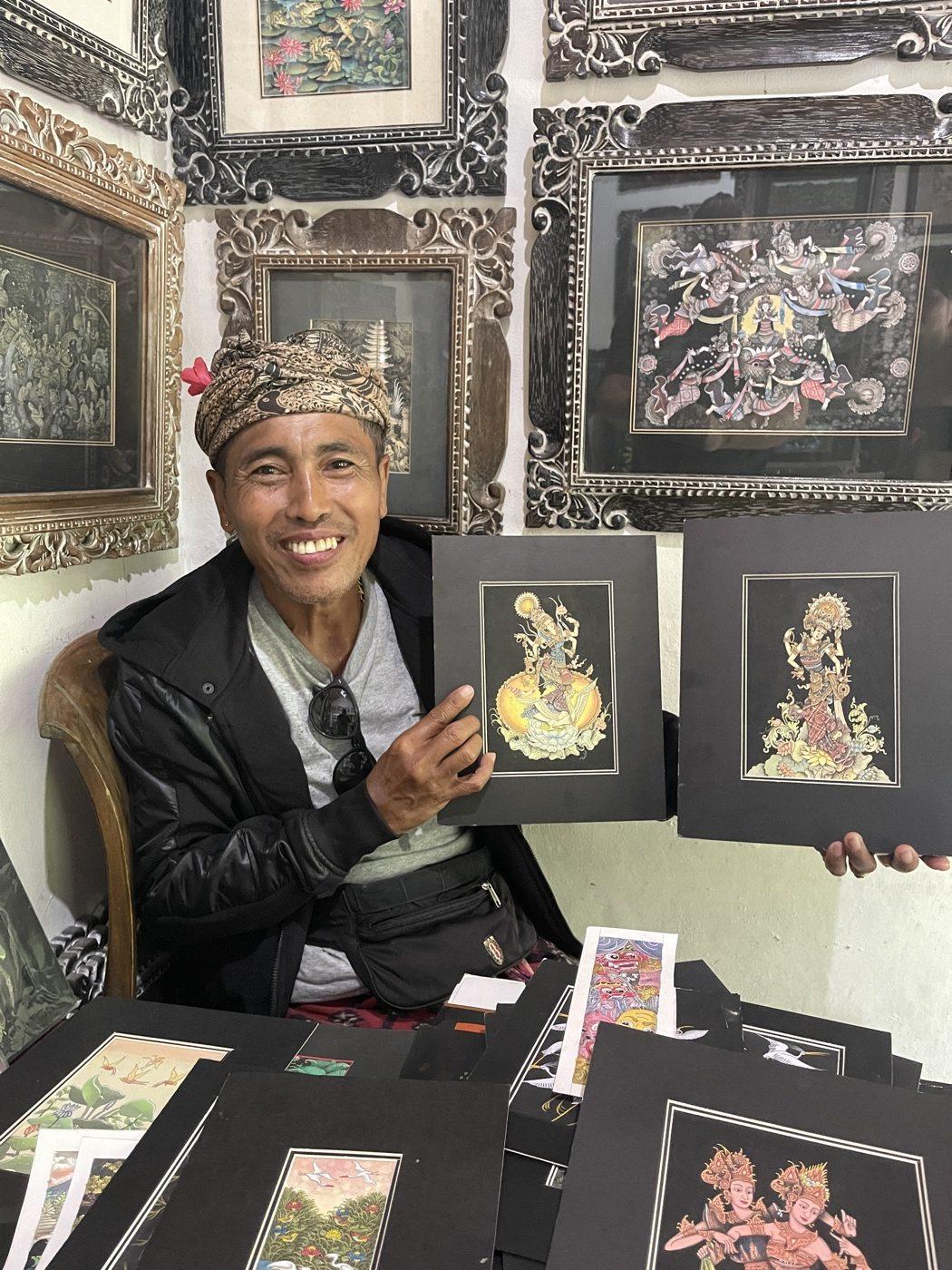
Some artists you find in a gallery. Marjana you find in a village in northern Bali — in the studio where her father painted before her, and his father before him.
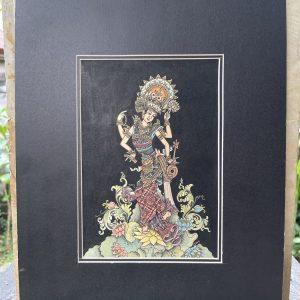
She works in the Keliki tradition: hand-painted miniatures born in the 1960s in Ubud, when village painters began reducing temple frescoes to portable formats. Every canvas is a world. Every brushstroke, an irreversible decision.
What Marjana’s hands tell
The Keliki tradition has no shortcuts. First the ground: layers of Chinese white, dried in the sun. Then the line drawing — Indian ink, fine brush. Then colour, applied inside the contours with a patience measured in days. A nymph’s face takes three hours. A jungle background can take ten.
Marjana paints what she knows: the Bidadari — celestial nymphs who move through Balinese ceremonies since the Sanskrit texts. Ritual masks that summon spirits during religious festivals. Saraswati, the goddess of knowledge and the arts, whose festival is celebrated across the island every 210 days of the Pawukon calendar.
These subjects aren’t chosen to please a market. They’re chosen because they are part of ordinary life in Bali — the religious calendar, neighbourhood ceremonies, morning offerings. A Marjana canvas isn’t a reproduction. It’s a fragment of living practice.
Three pieces, one artist
Balinese Spirits and Masks — €250

A ritual mask surrounded by the dense vegetation of the Balinese jungle. Masks in this tradition summon benevolent spirits during festivals of the Hindu-Balinese calendar. The composition plays on ambiguity: what protects can also frighten. That’s intentional.
Saraswati — €400

The Hindu goddess of knowledge, language and the arts, rendered in classical Balinese iconography: white robes, lotus flower, musical instruments. In Bali, the Saraswati festival marks the day when sacred books are honoured — a day not to read, but to give thanks for the ability to read. This canvas was painted for that festival.
Bidadari — €600

The celestial nymphs. In Balinese mythology inherited from Javanese and Sanskrit texts, the Bidadari descend from the sky during ceremonies to purify ritual spaces. Marjana paints them in flight, surrounded by Balinese paradise flowers and birds. This is the most ambitious piece in the series — and the largest.
Why these canvases travel
Keliki miniatures began leaving Bali in the 1970s, carried by early travellers who understood they were holding something irreplaceable. Today the finest pieces from this tradition are in private collections in Amsterdam, Tokyo, Sydney, Paris.
What makes them travel is their density. Across 20 cm by 15 cm, Marjana places more visual information than a standard-format canvas. Every millimetre is worked. You can look at one of her miniatures for ten minutes and keep finding new details.
This is not decoration. It’s contemplation with a frame.
All three pieces are available at the Marjana collection page. Each piece is unique, signed, and arrives with a certificate of authenticity.
In our shop
-
Sale!

Saraswati — Original Keliki Miniature by Marjana
Original price was: €998.00.€400.00Current price is: €400.00.