How to Choose a Chinese Calligraphy Set: History, Tools, and Materials
In China, mastering Chinese calligraphy is considered a sign of intelligence. It’s an artistic discipline expressed through the choice of characters and the way they’re traced. The practice of Chinese calligraphy is often compared to learning to walk: in Chinese teaching, studying the Regular script is like learning to stand up straight.
Discover our full collection of Asian handcrafted objects for your space and your practice.
This art has evolved over millennia, becoming increasingly widespread both within China and around the world. How do you choose a Chinese calligraphy set that honors the tradition while fitting a modern practice? The choice becomes much easier once you understand the origins of this traditional Chinese culture that has endured through time.
Origins of Chinese Calligraphy
Beneath the surface of Chinese culture lies a very ancient wisdom. Writing is an art form in its own right, steeped in philosophy and self-mastery. The ink leaves no room for error, which demands unwavering confidence from the calligrapher. Before choosing your calligraphy set and starting this practice, here’s a brief look at its history.
A Very Ancient Form of Writing
Chinese characters have existed since ancient times. Also called Shu Fa, Chinese calligraphy is part of the traditional art of Asian writing. Specialists agree that the Chinese people have been putting their thoughts to paper for roughly four thousand years, well ahead of the Romans, who took up writing many centuries later.
Nos Kits de Calligraphie
Pinceaux, encre et pierre à encre : la calligraphie chinoise authentique.
Voir la calligraphie →Who Started Chinese Calligraphy?
Opinions differ on its origin. Some claim it was Fuxi, the first Chinese Emperor, who initiated it. Other schools of thought credit Cang Jie as the one who drew the first characters. According to tradition, the greatest Chinese calligrapher is Wang Xizhi, who influenced a great number of calligraphers and scholars across Asia.
The Philosophy Behind Calligraphy
If you’ve chosen to get a calligraphy set online, or simply found your way to this article, you’ve likely understood there’s something to be gained from it. Tracing characters is designed as a way to connect mind and body. The effects resemble meditation: it builds self-mastery and lifts the practitioner toward a higher spiritual dimension.
Mastering Calligraphy and Social Rank
There are tens of thousands of Chinese characters. Mastering this writing system necessarily unfolds over a period that can span a decade or an entire lifetime. Taking up this discipline means committing to a long path. During the imperial era, calligraphy was used to select people for positions of responsibility at the imperial court, since it reflected a person’s emotions, level of education, moral integrity, and personality.
Chinese Calligraphy’s Evolution
Across the different dynasties and schools of thought, trends in Chinese calligraphy have shifted. The basic design has stayed the same, but styles evolved according to the needs of each era’s rulers. Modern calligraphy is therefore slightly different from the traditional form. Still, the four pillars, also called the “calligrapher’s treasures,” remain the same.
Choosing a Traditional Calligraphy Set
People choose a traditionally presented calligraphy set for different reasons: respect for custom, or simply as an interior decoration piece. It generally includes an ink stick made from soot and musk, an inkstone, rice paper, and a brush, arranged carefully and harmoniously in a wooden box. It’s more favored by calligraphy experts.
Choosing a Modern Calligraphy Set
A modern calligraphy set is especially useful for getting started, since it’s much easier to handle. Unlike a traditional set, a modern one doesn’t require grinding ink on the stone to get the right texture. The ink comes in a liquid container: to use it, simply pour it into the inkwell and dilute it slightly if needed.
The Brushes Used in Calligraphy
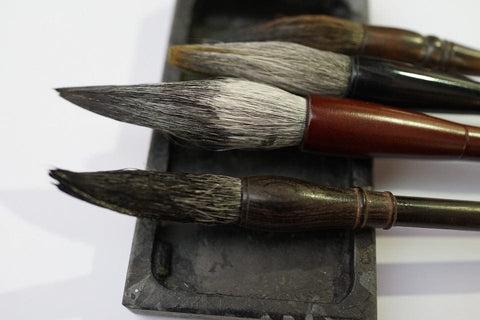
Chinese students today increasingly write with a pen, and a Chinese computer keyboard now handles characters directly, with no need to trace them by hand. But without the brush, calligraphy isn’t quite the same art.
Why Are Brushes So Important in Calligraphy?
In traditional Chinese art, the brush is an extension of thought, and the connection passes through the body. The writing tool is an integral part of the visual art that results from it. Choosing a calligraphy set, and the result you’re hoping to achieve, depends on the quality of the brushes and the variety of models available.
Brush Design and Shape
When choosing your calligraphy materials, know that weight, shape, bristle length, and bristle arrangement vary widely: every calligrapher has their own preferences and style. Wrist strength and flexibility both influence which brush suits tracing characters best.
Four qualities to look for:
- Sen (sharpness): choose a brush with a fine point for precision.
- Sei (structure): look for a brush with longer bristles that stay the same length once flattened.
- En (resilience): bristles that are neither too soft nor too stiff, so the brush turns easily in water or ink.
- Ken (balance): well-balanced bristles that follow the movements given to them.
For more advanced practitioners, other brush shapes exist on the market (round tip for rounded strokes, flat tip, and so on).
Which Materials to Choose?
Traditional calligraphy brushes generally have a wooden handle, often bamboo, and bristles made from animal hair.
- Goat hair: softer, usually white.
- Wolf hair: light to dark brown, stiffer.
- Weasel hair: light brown with a white tip, for very precise strokes.
- Marten hair: bushier bristles.
Some brushes mix bristle types, for example half goat hair and half rabbit hair, or 70% rabbit hair and 30% goat hair.
Caring for Your Brushes
Proper brush care matters, so they don’t wear out too quickly. A new brush’s bristles are typically stiff, coated in glue to protect them during shipping.
- Before first use, remove the glue coating by gently rolling the bristles in the palm of your hand under running water, without pressing.
- After each use, rinse the brush under running water the same way. Hold the brush upright and avoid soaking the handle.
- Avoid leaving the brush sitting in a bowl of water, which risks damaging the tip.
- To work ink out from deep in the bristles, gently press them to reshape the tip into a point.
- To dry, hang the brush with the tip pointing downward.
Chinese Ink for Good Calligraphy
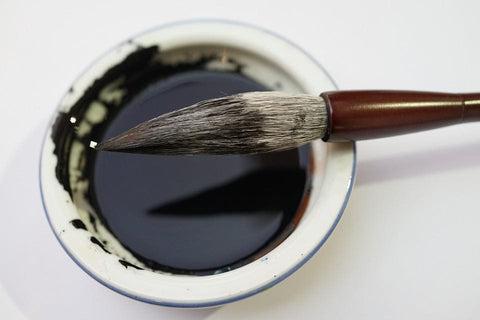
Indelible and always black, traditional Chinese ink is distinctive both in how it’s made and how it’s used. Modern, easier-to-use alternatives now exist, particularly suited to beginners. It’s up to you to choose what fits your practice.
Getting Traditional Chinese Ink
When choosing a traditional Chinese calligraphy set, the ink comes as a raw black stick, a rod made by burning specific woods and oils to produce that black color.
What Makes Chinese Ink Distinctive
When you grind the stick against the inkstone with a little water, you get a liquid texture, ranging from fluid to slightly thick, depending on the user’s intention and the result they’re after. A calligrapher’s style is shaped by how concentrated the ink is and how it leaves its mark on the paper.
What About the Inkstone?
One of the four essential “treasures” of the calligrapher is the inkstone. It’s a work of art in its own right, personal to its owner, and needs careful upkeep.
The Inkstone’s Role in Chinese Calligraphy
This special tool holds and dilutes the Chinese ink. A black paste forms as the ink stick is ground against the stone’s rough, pre-moistened surface. This ritual is meant to happen before writing begins, to prepare the mind and body.
The Nature of the Inkstone
When choosing your calligraphy set, check the quality of the stone carefully. Inkstones are generally made from jade or porcelain. Look for a stone with a smooth, satiny surface to the touch. A good-quality stone produces fine, rich ink quickly and won’t damage the brush’s bristles. As for shape, you can choose between round or rectangular, depending on your preference.
Caring for Your Inkstone
Rinse the inkstone with water and a soft sponge after each use. Starting with a clean surface matters before beginning any calligraphy session. Ink can also damage the stone if left to dry on it, since it tends to bond to the surface.
What About the Paper?
As mentioned above, traditional calligraphy paper is made from rice flour or rice straw. It’s called Xuan Zhi, and comes in two main types:
- Shengxuan: absorbent paper, the most widely used across Asia.
- Shu Xuan (or Fan Xuan): far less absorbent, less commonly used.
Other alternatives appeared later:
- Maobianzhi: made from grass fiber, with a yellowish color. Recommended for beginners due to its much lower price compared to traditional papers.
- Yuanshu: thin and light, made mainly in the Fuyang region from young bamboo pulp. White in color, this paper is soft and absorbent, and recommended for beginners.
Now that you know everything about Chinese calligraphy and the tools needed to practice it well, all that’s left is to make your choice. At Artisan d’Asie, we offer handcrafted calligraphy sets for beginner, intermediate, and expert levels.