How to Choose an Incense Holder: Stick Holders, Backflow Burners, and Censers Explained
Not all incense holders do the same job. A stick holder, a backflow burner, and a censer for loose resin are three different tools built around three different ways of burning incense, and using the wrong one is the most common reason people think incense “doesn’t work” for them.
This guide covers the three main types, how each actually works, how to pick the right one for the incense you already have, and how to care for it once you do.
Stick Holders
The simplest and most common type: a base with a small hole or groove that holds an incense stick at an angle, with a tray or dish beneath to catch falling ash. Smoke rises normally from the burning tip, the way people generally picture incense working.
Stick holders work with standard incense sticks only, whether bamboo-core or solid. They’re the right choice if you want a slow, rising trail of smoke and a design object you can leave out permanently, such as a carved lotus or metal stand with the incense passing between sculpted petals.
Backflow Burners
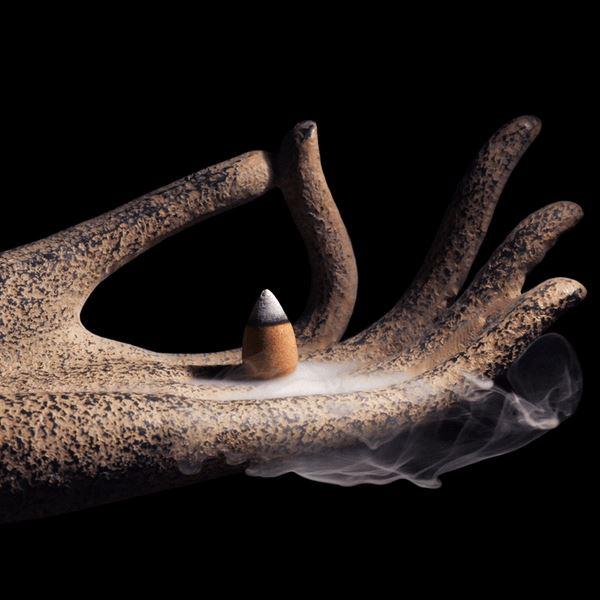
Backflow burners rely on a specific physical effect: as the smoke from a backflow cone cools just above the flame, it becomes denser than the surrounding air and sinks instead of rising. Carved ceramic burners channel that sinking smoke down through a hollow interior and out along a sculpted surface, be it a mountain, a lotus, or an open palm, producing a slow-moving cascade that pools and dissipates at the base rather than climbing toward the ceiling.
Nos Encens Naturels
Bois d'oud, santal, résines. Encens naturels, sans parfum de synthèse.
Voir les encens →This only works with backflow cones, which have a hole through the center to create the airflow path. A regular stick or standard cone will simply burn upward on a backflow burner and produce no cascade at all. If you already burn standard sticks or cones, a backflow burner will not work for you without switching incense formats.
Because the effect depends on the smoke traveling down a carved channel, backflow burners are almost always ceramic: the material holds fine sculptural detail and resists the heat where the cone sits far better than metal alternatives at this price point.
Censers for Loose Resin and Charcoal
A censer or incense burner is built for loose resin, herbs, or charcoal disks rather than pre-shaped sticks or cones. Because the charcoal itself burns hot, censers need a layer of ash or sand inside to insulate the base and prevent heat damage to whatever surface they sit on. This format is closer to traditional temple or ceremonial burning and gives the most control over how much material burns and for how long, at the cost of more setup than lighting a stick.
Brass and copper censers are the traditional material here: the metal handles sustained heat well and the weight suits a ritual object meant to stay in one place, on an altar or meditation space, rather than travel around a room.
Choosing by What You Already Burn
- Standard incense sticks: a stick holder with an ash tray. Any backflow burner will not create the cascade effect with a regular stick.
- Backflow cones (hollow-center cones designed for the effect): a ceramic backflow burner. Check the burner’s chamber size against your cone diameter before buying, since backflow cones vary slightly by maker.
- Loose resin, herbs, or charcoal disks: a censer with an ash or sand bed. Never burn charcoal disks directly on a stick holder or backflow burner; both are built for the lower, steadier heat of pre-shaped incense.
Caring for Your Incense Holder
Empty ash trays and chambers regularly. Ash left sitting absorbs moisture and can affect how cleanly the next stick or cone burns. On backflow burners specifically, smoke residue gradually coats the interior channel the smoke travels through; if the cascade effect weakens over time even with a fresh cone, the channel likely needs cleaning with a soft brush or cotton swab. Ceramic pieces can generally be wiped with a dry or slightly damp cloth; avoid soaking glazed ceramic with cracks or hairline crazing, since trapped water can widen them over time. Metal and brass censers benefit from an occasional wipe with a dry cloth to prevent tarnish, particularly if used often with resin, which leaves more residue than sticks or cones.
Symbolism to Consider
Beyond function, the sculptural form of a holder often carries its own meaning. The lotus, the most common motif across all three types in Buddhist and Chinese iconography, represents purity and awakening because it grows up clean through mud without being stained by it. A Buddha’s hand, used on some backflow designs, references the mudras (ritual hand gestures) used throughout Buddhist iconography to signify a particular teaching or blessing. Feng shui stone arrangements on backflow burners are meant to evoke a mountain landscape, tying the smoke’s downward movement to the idea of energy settling rather than dispersing upward and away.
In Our Shop
- Ceramic Zen Stones Backflow Incense Burner
- Lotus & Frog Ceramic Backflow Incense Burner
- Buddha Hand Backflow Incense Burner
- Lotus Alloy Incense Holder
- Pure Brass Incense Burner
Discover our full incense holder collection →
Frequently Asked Questions
Can I use a regular incense stick in a backflow burner?
No. Backflow burners require backflow cones, which have a hollow center that creates the airflow needed for smoke to sink instead of rise. A regular stick will just burn normally with no cascade effect.
Why has the smoke cascade on my backflow burner stopped working?
The most common cause is residue buildup inside the smoke channel from repeated use. Clean the interior with a soft brush or cotton swab. Damp or low-quality cones can also produce a weaker effect.
Can I burn charcoal disks in a stick holder or backflow burner?
No. Charcoal disks burn much hotter than sticks or cones and are designed for censers with an ash or sand bed for insulation. Using one in a holder not built for that heat level risks damaging the piece.