Jade Stone: Nephrite, Jadeite, and Symbolism in Chinese Tradition
The term “jade” refers to two distinct minerals that share a similar visual appearance but different molecular structures: nephrite and jadeite. Nephrite is a magnesium and calcium silicate, belonging to the amphibole family. Jadeite is an aluminum and sodium silicate, belonging to the pyroxene family. In China, the term yu (玉) historically designated both without distinction, though the hierarchy of value between the two varieties has been recognized in the lapidary tradition since the 19th century.
Jade in Chinese civilization
Jade holds a place in Chinese tradition that no other stone holds in any other culture. Its use dates to the Neolithic period: the Hongshan (3500-2000 BCE) and Liangzhu (3300-2200 BCE) cultures produced nephrite ritual objects — bi discs, cong tubes, dagger-shaped blades — whose precise function remains debated. The scarcity of the material, the difficulty of working it, and its distinctive physical properties — impact resistance, resonance, translucency — made it a marker of social rank and a medium of communication with natural forces.
The value attributed to jade in Chinese tradition exceeds that of gold and silver. Confucius compared jade’s qualities to moral virtues: the smoothness of its polished surface to benevolence, its translucency to wisdom, its resistance to courage, its sharp edges to fairness, and the clarity of the sound it produces when struck to purity.
Nephrite and jadeite: two distinct minerals
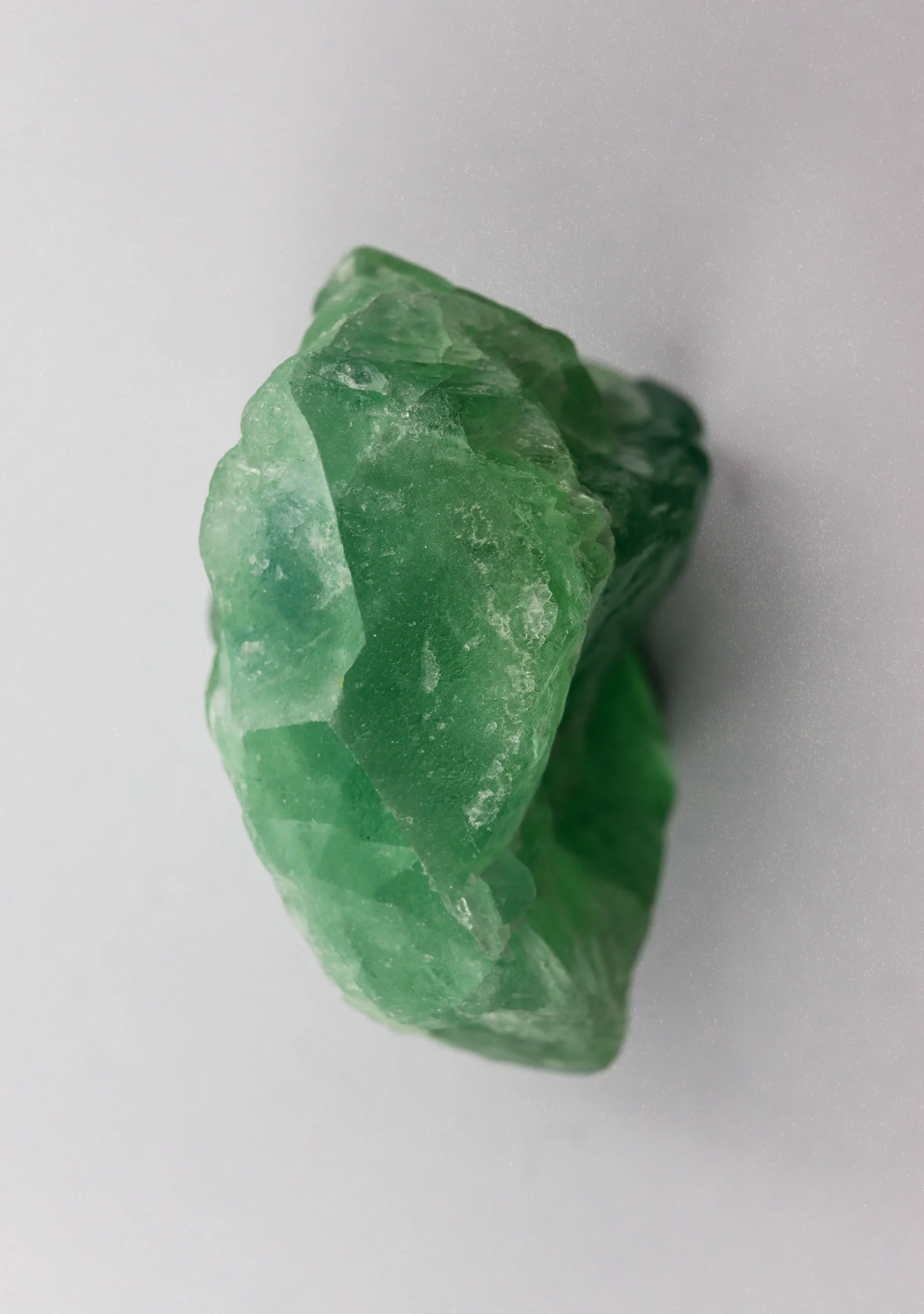
Nephrite — the historically dominant variety in China — is distinguished by an interlocked fibrous structure that gives it impact resistance greater than granite. Its hardness is 6 to 6.5 on the Mohs scale. Classic nephrite deposits in China are found in Xinjiang (Khotan jade, celadon to creamy white in color) and Liaoning province. Other significant deposits are in Siberia, New Zealand, Canada, and Poland.
Jadeite, introduced to China from Burma (present-day Myanmar) in the 18th century, is characterized by more intense colors — translucent imperial green is the most sought-after form — and a finer-grained crystal structure. Its hardness is slightly higher: 6.5 to 7 Mohs. Lavender, white, and orange jadeite also appear on the market, but green corresponds to the canonical image of jade in China.
The symbolic meaning of jade
In classical Chinese cosmology, jade is associated with the five elements and the five directions. The bi disc — a flat jade ring — represents heaven. The cong tube — a rectangular external form with a cylindrical internal channel — represents the earth. These ritual forms, with the oldest examples dating to the Neolithic period, were used in funerary ceremonies, ancestral communication rites, and as investiture objects.
Jade is also associated with longevity in Chinese tradition. Ancient Taoist texts attribute preservative properties to jade, and the elites of the Han dynasties (206 BCE – 220 CE) enclosed noble bodies in jade burial suits assembled with gold, silver, or bronze thread according to the rank of the deceased.
Forms and uses in jewelry
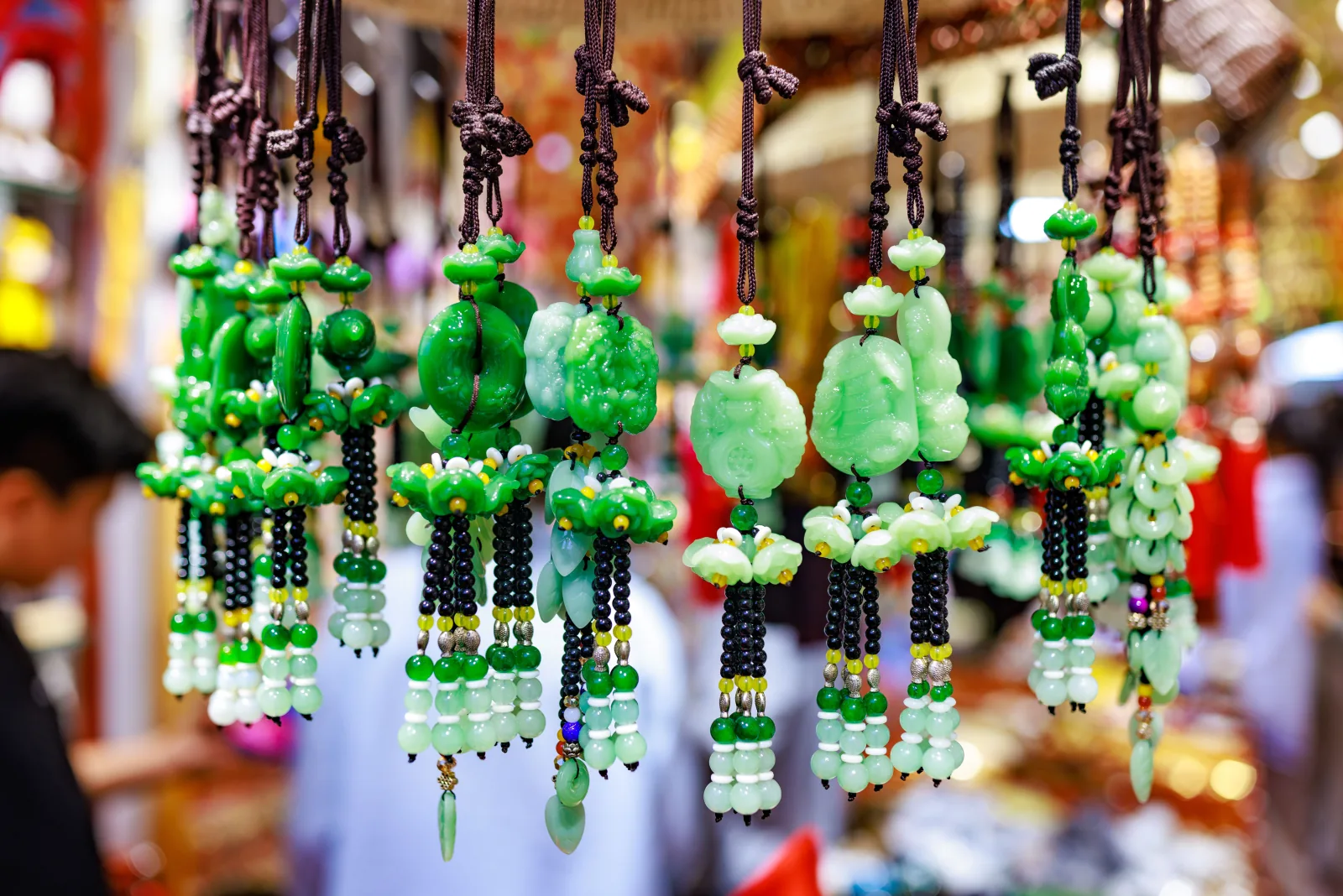
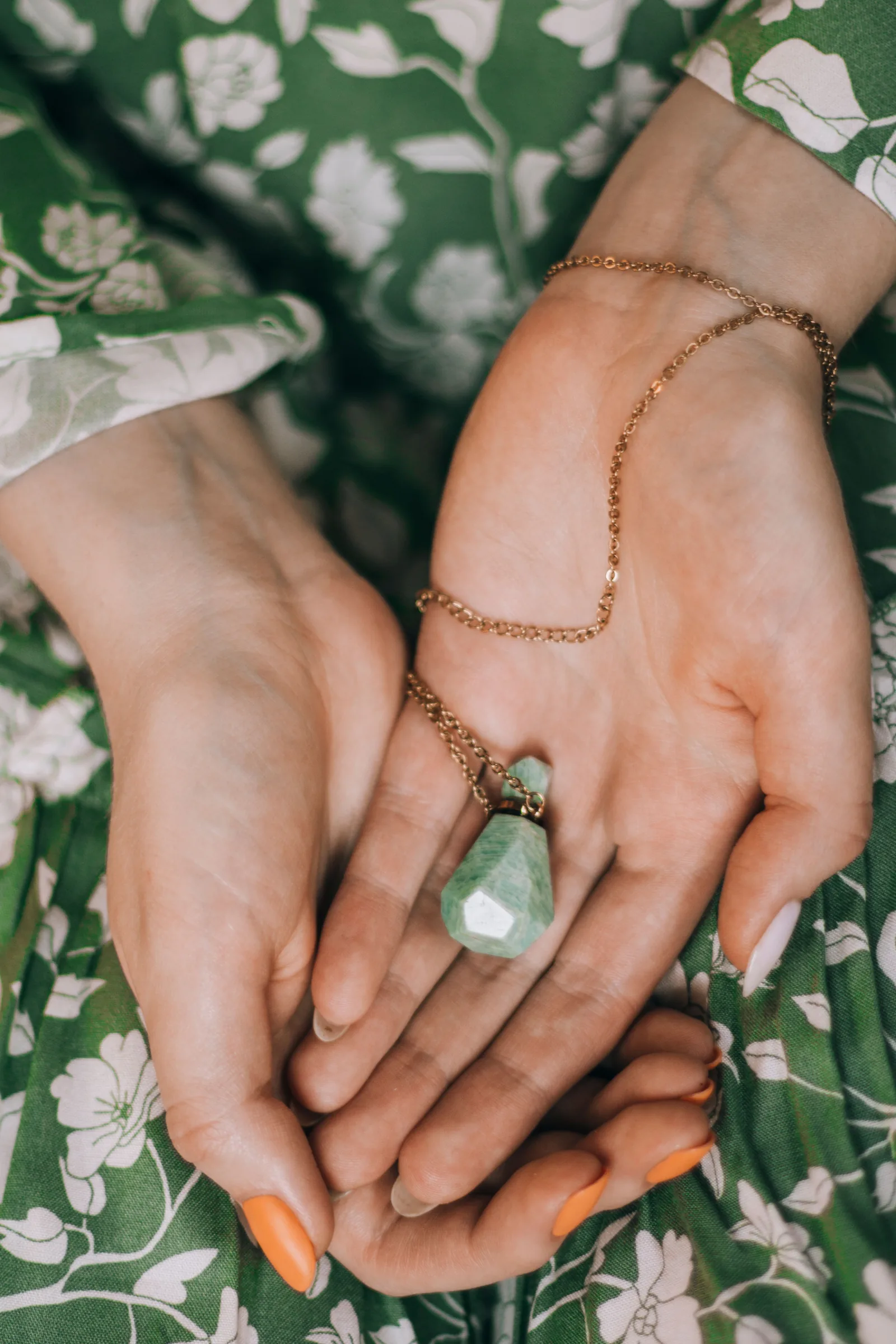
Traditional jade jewelry forms include:
- Fish pendant: symbol of abundance, luck, and continuity — the word for fish (yu) is a homophone of surplus in Mandarin
- Dragon pendant: associated with strength, transformation, and protection
- Guanyin pendant: representation of the goddess of compassion, worn for protection and benevolence
- Bangle bracelet: nephrite worn in direct and continuous contact with the skin — the only jade object the tradition recommends wearing at all times
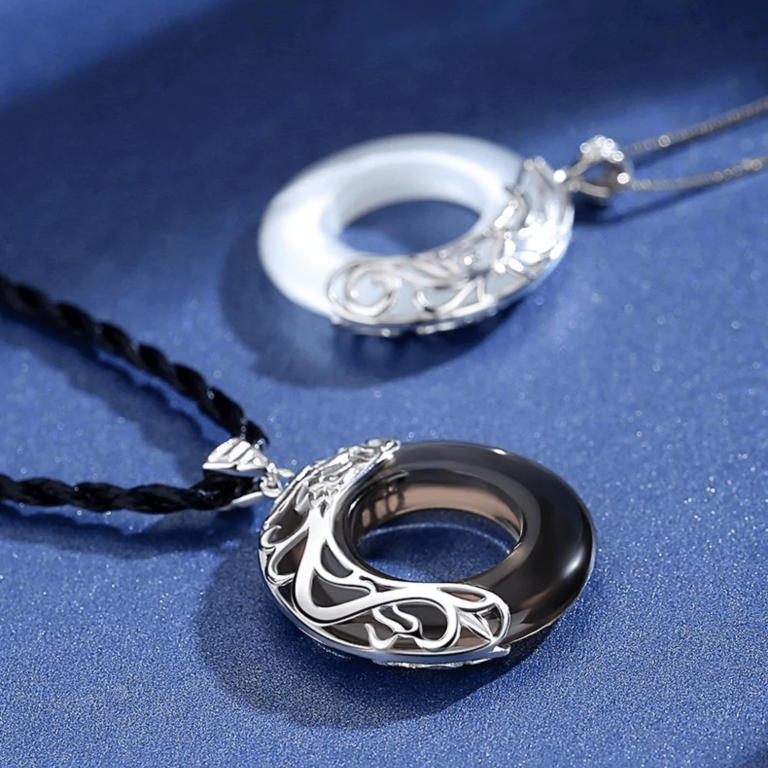
- Bi amulet: ring-form pendant, the cosmological form associated with the harmony of heaven and earth
Identifying authentic jade
Distinguishing authentic jade from imitations (serpentine, aventurine, dyed green onyx, colored glass) relies on several tests:
- Sound test: jade produces a clear, sustained tone when lightly tapped against another jade piece or a hard object — a sound distinct from glass or synthetic imitations
- Thermal test: jade remains cool to the touch longer than glass or plastic imitations, due to its higher thermal conductivity
- Density: nephrite (density 2.9-3.1) and jadeite (density 3.2-3.4) are noticeably denser than serpentine (2.5-2.6) or glass (2.4-2.8)
Definitive identification requires spectroscopic analysis (Raman or Fourier-transform infrared spectroscopy) to distinguish nephrite from jadeite and from all treated imitations. For pieces of significant value, a gemmological certificate is recommended.
Incorporating jade into daily practice
In Chinese tradition, jade is worn in direct contact with the skin, not displayed under glass. Jade bangles and pendants are objects for daily use: prolonged contact is considered beneficial, and the patina jade develops over time — bao zheng (包漿), literally “encapsulating coating” — is valued as evidence of an object that has absorbed human warmth.
Bao zheng is visible as a slight lustring of the surface that differs from the original polished finish: softer, slightly more translucent, developed only at the points of contact. Ancient jade showing this patination is considered more desirable than an identical unpatinated piece — which distinguishes jade from most other ornamental stones, where surface wear reduces value rather than adding it.
In our shop
-

-
-
-
Dragon Moonstone Round Pendant – Sterling Silver 925
Price range: €69.00 through €99.00Secure Yours This product has multiple variants. The options may be chosen on the product page


Version française : Le jade : néphrite, jadéite et symbolique dans la tradition chinoise