Buying Guide: How to Choose Your Tibetan Singing Bowl
Zen decor, meditation, restoring a sense of calm, recharging a mala or natural 7-chakra stones with positive energy: the reasons for choosing a Tibetan singing bowl are varied. Knowing its history, its different uses, and the meaning behind the materials it’s made from makes it much easier to know what to look for.
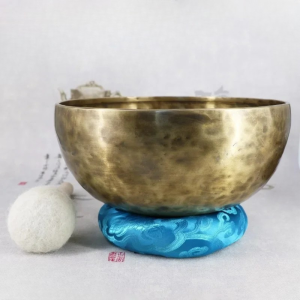
Our hand-hammered copper singing bowl and our double-thickness copper singing bowl are handmade and selected for their sound quality.
History and Origin of the Tibetan Singing Bowl
Simple at first glance, the Tibetan bowl has been used for spiritual and therapeutic purposes for millennia. According to some studies, the first singing bowls appeared as far back as 5,000 years ago. Shamanism, or the Bon tradition, is often credited as the route by which the singing bowl entered Buddhist practice.
If you’re looking to buy a Tibetan singing bowl, it helps to know its history first.
Once used as a kitchen utensil
The singing bowl is a genuinely old object: its earliest uses predate the arrival of Buddhism in Tibet, when it served to hold food and water like any other everyday kitchen vessel.
Nos Bols Chantants
Bols tibétains martelés à la main, accordés pour la vibration.
Voir les bols chantants →A very old shamanic tool
According to some scholars of Asian culture, shamans are believed to have already made use of this particular bowl’s properties, employing it in spiritual practices often tied to healing and the treatment of various ailments.
Use by Buddhist practitioners
With the arrival of Buddhism, the bowl’s use became more defined. It is generally used in rituals and funeral ceremonies, but its use has since spread into meditation practice, notably among Buddhist monks. In other traditions, such as Hinduism, the chakras are said to be directly affected by the tone of a Tibetan bowl.
The Different Uses of the Tibetan Bowl
Today, sound waves are increasingly recognized and studied for their healing and therapeutic properties. Light and sound both belong to this broader category of waves, alongside electromagnetic signals and atomic radiation, in the same family as light therapy, chemotherapy, or radiotherapy.
The tone produced by a Tibetan bowl can also affect the mind and the body’s sense of wellbeing. Before you get a Tibetan singing bowl of your own, here are a few of its benefits.
- For meditation: the positive vibrations produced by a Tibetan singing bowl are said to guide the practitioner toward stillness. The effect is similar to reciting mantras while counting through a mala necklace, or breathing in the scent of natural incense such as oud wood incense.
Our hand-hammered copper singing bowl and our double-thickness copper singing bowl are handmade and selected for their sound quality.

The Materials Used to Make a Bowl
A traditional Tibetan bowl is made entirely of metal, though crystal singing bowls also exist. Each material produces its own vibration and yields a different tone depending on the bowl’s thickness and dimensions. Every metal has its own particular character.
These are the metals traditionally said to appear in the composition of a Tibetan singing bowl:
- Gold
- Silver
- Mercury
- Tin
- Copper
- Iron
- Lead
As you’ll notice, there are seven metals in this list, and that number is no coincidence: it corresponds to the number of the main chakras, as well as to the seven classical celestial bodies.
As mentioned above, each material is said to correspond to a particular energy center, listed below by its associated chakra:
- Crown chakra
- Third eye chakra
- Throat chakra
- Spleen chakra
- Heart chakra
- Solar plexus chakra
- Root chakra
A bowl can be made from an alloy of all seven metals, or from a combination of just two or three.
The Dimensions of the Tibetan Bowl
As noted above, a bowl’s dimensions also play an important role in its sound. Diameter, height, and wall thickness can all affect the tone and its felt effect on the body. Choose the size of your singing bowl based on how you intend to use it.
- The small bowl: lighter and easy to hold in one hand. Small singing bowls measure around 10cm in diameter and weigh at most 300 grams. Their tone is higher and brighter, well suited to concentration. This is the ideal size for a meditation practice.
- The large bowl: larger bowls are heavier, with a minimum diameter of around 25cm. They can’t easily be held in one hand and are better rested on a soft cushion so the bowl’s tone can be heard clearly. The larger the bowl, the deeper and more resonant the sound, and the more it’s felt through the body. Larger bowls are more often used for balancing the chakras.
Note that the thicker and deeper a bowl is, the heavier it will be, and its tone will change accordingly. Choosing a singing bowl ultimately comes down to the sound that moves you.
Finding the Tibetan Bowl That’s Right for You
By now you should already have a good sense of which Tibetan singing bowl you want to buy. Here are a few additional pointers before you finalize your choice.
Listen before you buy
If you’re buying in person, don’t hesitate to ask to test the bowl and hear its tone. A Tibetan bowl can be played in a few different ways:
- a quick, sharp strike with a mallet, similar to a gong. Let the vibration fade or stop, then strike again.
- gently run a finger around the rim to draw out a soft tone.
- run the mallet slowly around the rim. The resulting tone will be calmer and more sustained.
Let the design guide you
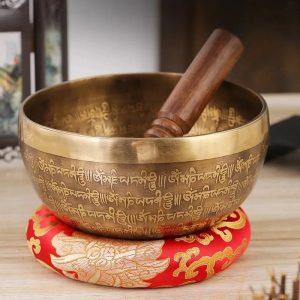
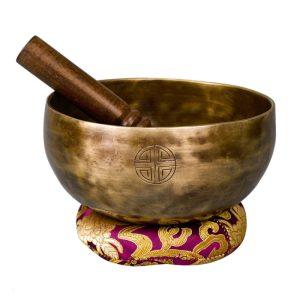
A handcrafted singing bowl comes in different materials, shapes, and patterns. The traditional Tibetan bowl takes the form of an inverted bell. You can choose between a fully smooth bowl or a hammered one, which lends a handmade, vintage character to the piece.
As for patterns, a singing bowl may be left plain or engraved with symbols significant in Buddhism, such as the lotus flower, mandalas, mantras, and more.
You should now be ready to make your choice. Which Tibetan bowl do you prefer, or have you already used one? What did it feel like?
In our shop
-

Copper Buddhist Singing Bowl with Inscriptions
Price range: €199.38 through €429.38Secure Yours This product has multiple variants. The options may be chosen on the product page -
Golden Harmony Tibetan Singing Bowl
Price range: €109.38 through €336.38Secure Yours This product has multiple variants. The options may be chosen on the product page -
Hand-Hammered Copper Singing Bowl
Price range: €136.38 through €499.38Secure Yours This product has multiple variants. The options may be chosen on the product page -
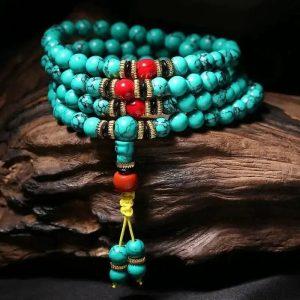
Natural Turquoise Mala Sacred Protection Wholeness
Price range: €139.38 through €486.38Secure Yours This product has multiple variants. The options may be chosen on the product page