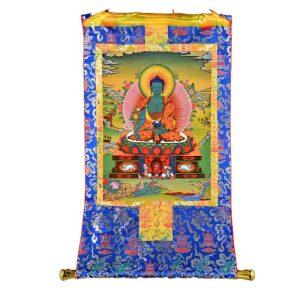
Guanyin Thangka Painting – Sacred Buddhist Art
€46.68
Guanyin thangka painting hand-painted on cotton canvas with mineral pigments including azurite, lapis lazuli, cinnabar, and gold, with silk brocade border, lacquered dowels, and linen backing, overall approximately 40 x 90 cm and weighing 425 grams. A devotional work from a workshop in active practice, ready to hang with its included silk cord.
EU orders: flat €3 customs duty (EU reform July 2026). Paid directly to the EU — no markup by Artisan d'Asie. Waived on orders ≥ €150.
Free shipping on orders over €80!
- Satisfaction Guaranteed
- No Hassle Refunds
- Secure Payments
Description
A Guanyin thangka painting is a hand-painted Buddhist devotional work on prepared cotton canvas, depicting the Bodhisattva of Compassion using mineral pigments including azurite, malachite, cinnabar, lapis lazuli, and gold. Made to be hung and lived with over years, it functions as a focal point for meditation, a devotional offering, or a work of sacred art in a home or practice space.
The painted surface measures approximately 40 cm wide by 60 cm tall and is executed on double-stretched cotton canvas prepared with a chalk ground. Mineral pigments — including azurite blue, lapis lazuli for deep backgrounds, cinnabar, malachite green, vermillion, and gold — are bound in hide glue and built up in layered washes, each allowed to dry before the next is applied. A silk brocade border frames the painting, extending the total hanging length to approximately 90 cm. Two lacquered wooden dowels, top and bottom, hold the work flat under its own weight. A plain linen backing protects the reverse. A removable silk veil covers the face of the painting. Total weight is approximately 425 grams. A silk hanging cord is attached and ready to use.
Hang the thangka on a wall using the silk cord at the top dowel, at a height where the figure of Guanyin is at eye level or slightly above when seated. The removable silk veil is traditionally drawn across the face of the painting when it is not in active use, a convention that treats the thangka as a living presence rather than a static decoration. No framing is required. Keep away from damp walls and direct sunlight, which can fade mineral pigments over time.
The thangka tradition originates in Tibet and extends into Nepal and China, where Buddhist monasteries commissioned portable devotional paintings for monks traveling teaching routes across mountain passes. Compositions are laid out according to proportions codified in canonical iconographic texts over centuries, with every element — the height of the figure, the angle of ornaments, the position of hands — prescribed by tradition. The figure of Guanyin, the Chinese transformation of the Sanskrit Avalokiteshvara, holds a vase of amrita in one hand and makes the gesture of grace with the other, a posture unchanged for fifteen centuries.
Do mineral pigment thangkas fade over time? High-quality mineral pigments in a properly stored thangka are extremely stable. Azurite and malachite retain their saturation for centuries when kept away from direct sunlight and damp. The primary risk is UV exposure, which causes gradual fading in any pigment; indirect natural light or warm artificial light will not cause visible change over a domestic lifetime.
Additional information
| Title | Default Title |
|---|