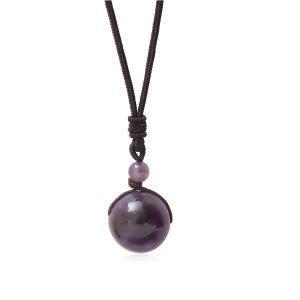
Labradorite Mala Necklace
€68.98
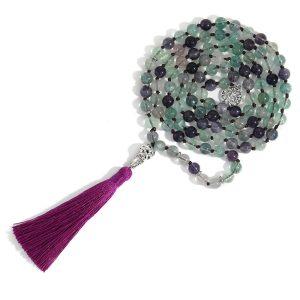
The Labradorite Mala Necklace is a 108-bead hand-knotted mala of natural iridescent labradorite at approximately 60 cm, following the Himalayan and Tibetan mala tradition, with a larger guru bead and hand-tied cotton tassel for over-the-head wear. Each 8 mm bead is hand-drilled and exhibits natural labradorescence — the shifting blue-green-gold iridescence produced by internal crystal structure.
EU orders: flat €3 customs duty (EU reform July 2026). Paid directly to the EU — no markup by Artisan d'Asie. Waived on orders ≥ €150.
Free shipping on orders over €80!
- Satisfaction Guaranteed
- No Hassle Refunds
- Secure Payments
Description
The Labradorite Mala Necklace is a 108-bead traditionally knotted mala strung with natural grey iridescent labradorite, following the Himalayan and Tibetan mala tradition, at approximately 60 cm in length. Each 8 mm bead is hand-drilled and individually tied, finished with a larger guru bead and a hand-tied cotton tassel at the base for over-the-head wear without a clasp.
The beads are natural labradorite of 8 mm diameter, selected for their characteristic labradorescence — the spectral blue, green, and gold iridescence produced by internal twinned crystal layers that shifts as the stone is moved in light. The base color is a cool grey, with the iridescent flash appearing most strongly when light strikes the stone at an angle. Each of the 108 beads is hand-drilled and hand-knotted on a traditional cord. The guru bead at the base is larger, marking the start and end of a counting cycle, and the cotton tassel is hand-tied to the guru bead.
Wear over the head as a single-strand necklace at approximately 60 cm, resting at the sternum. For mantra or breath counting, hold in both hands and move one bead per count toward the guru bead; reverse at the guru bead to begin a new cycle without crossing it. The no-clasp design is intentional in the Tibetan mala tradition — the continuous strand without a break represents the uninterrupted nature of practice. Store flat or coiled loosely in a soft pouch to protect the labradorite surface.
Labradorite, a plagioclase feldspar first formally identified on the Labrador coast of Canada, is also found extensively in Madagascar and Finland and has been used in Himalayan and Tibetan devotional objects for generations alongside more traditional materials such as turquoise, coral, and bone. Its dramatic optical property — labradorescence — is caused by light interference between nano-scale layers of alternating feldspar compositions, a purely structural color phenomenon. In Tibetan mala tradition, stones are chosen for their material properties as much as their visual qualities, and labradorite’s reflective depth makes it a meditative surface for sustained attention during recitation practice.
Will labradorite scratch or chip with daily mala use? Labradorite sits at Mohs 6 to 6.5, which makes it durable for mala wear against cloth and skin but susceptible to scratching from harder stones or metal if stored in contact with them. The hand-knotted construction keeps beads from rubbing each other directly during wear. The iridescent surface is structural, not a coating, so it cannot be worn or scratched away — the labradorescence is preserved as long as the stone itself is intact.
Additional information
| Title | Default Title |
|---|