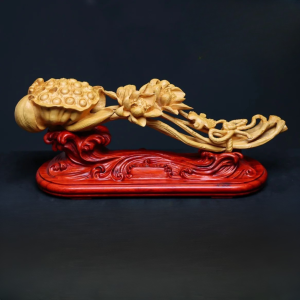
Carved Boxwood Lotus Ruyi Scepter
€1,168.68
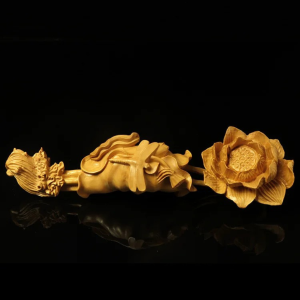
Carved boxwood lotus Ruyi scepter in single-piece Chinese boxwood with full lotus motif in high relief, approximately 19.5 x 6.1 x 4.7cm. A classical Chinese court and gift object associated with fulfilled wishes, hand-carved with a low matte finish that deepens with handling.
EU orders: flat €3 customs duty (EU reform July 2026). Paid directly to the EU — no markup by Artisan d'Asie. Waived on orders ≥ €150.
Free shipping on orders over €80!
- Satisfaction Guaranteed
- No Hassle Refunds
- Secure Payments
Description
The carved boxwood lotus Ruyi scepter is a hand-carved ceremonial object presenting the classical form of the Chinese court Ruyi in close-grained boxwood with a full lotus motif in high relief. Measuring approximately 19.5 x 6.1 x 4.7cm, it is the object most associated in Chinese culture with wishes fulfilled and authority conferred.
The scepter is carved from a single piece of boxwood, grain running lengthwise through the shaft for structural continuity. The head carries a full lotus in relief, petals undercut to create shadow depth. Secondary lotus elements appear at intervals along the shaft. The surface is hand-finished to a low matte tone that deepens with handling. Weight sits naturally toward the head, the traditional balance of the classical form. The overall dimensions are approximately 19.5 x 6.1 x 4.7cm. The wood is dense, close-grained Chinese boxwood (Buxus sinica), chosen for its capacity to hold fine carving detail without splitting.
The Ruyi is traditionally displayed on a stand, held in presentation, or placed flat on a desk or altar surface. It is a gift object first: the classical exchange between emperors and ministers. In contemporary use it is placed on a shelf or desk as a Feng Shui object associated with fulfilled wishes and authority. No stand is included; the flat underside of the shaft allows stable flat placement. A display stand appropriate to the dimensions can be sourced separately.
The Ruyi scepter has been present in Chinese court and scholarly culture since the Han dynasty. Its name means as you wish, making it the preeminent gift exchanged between emperors and ministers. The lotus motif belongs to a longer lineage: the flower associated in Buddhist and Confucian traditions with integrity and emergence from adversity. Boxwood, dense-grained and slow-growing, was the material of choice for precision carving in Suzhou workshops, where its tight grain held fine detail without splitting under the tool.
A question buyers ask is how this Ruyi should be maintained to preserve the boxwood surface. Boxwood is stable indoors and does not require routine oiling or sealing. The natural oils of the hand deepen the surface tone gradually with handling, which is the traditional finish process for this material. To clean, use a soft dry cloth. Avoid prolonged exposure to direct sunlight, which can lighten the honey tone over time. If the surface appears dry in very low humidity, a light application of natural beeswax will restore the matte finish without altering the detail.
Additional information
| Title | Default Title |
|---|
You may also like…
-

-
-
Ruyi en bois de pêcher sculpté
€1,168.88Secure Yours This product has multiple variants. The options may be chosen on the product page -